The Most Frightening Book I Read This Year Wasn’t Horror
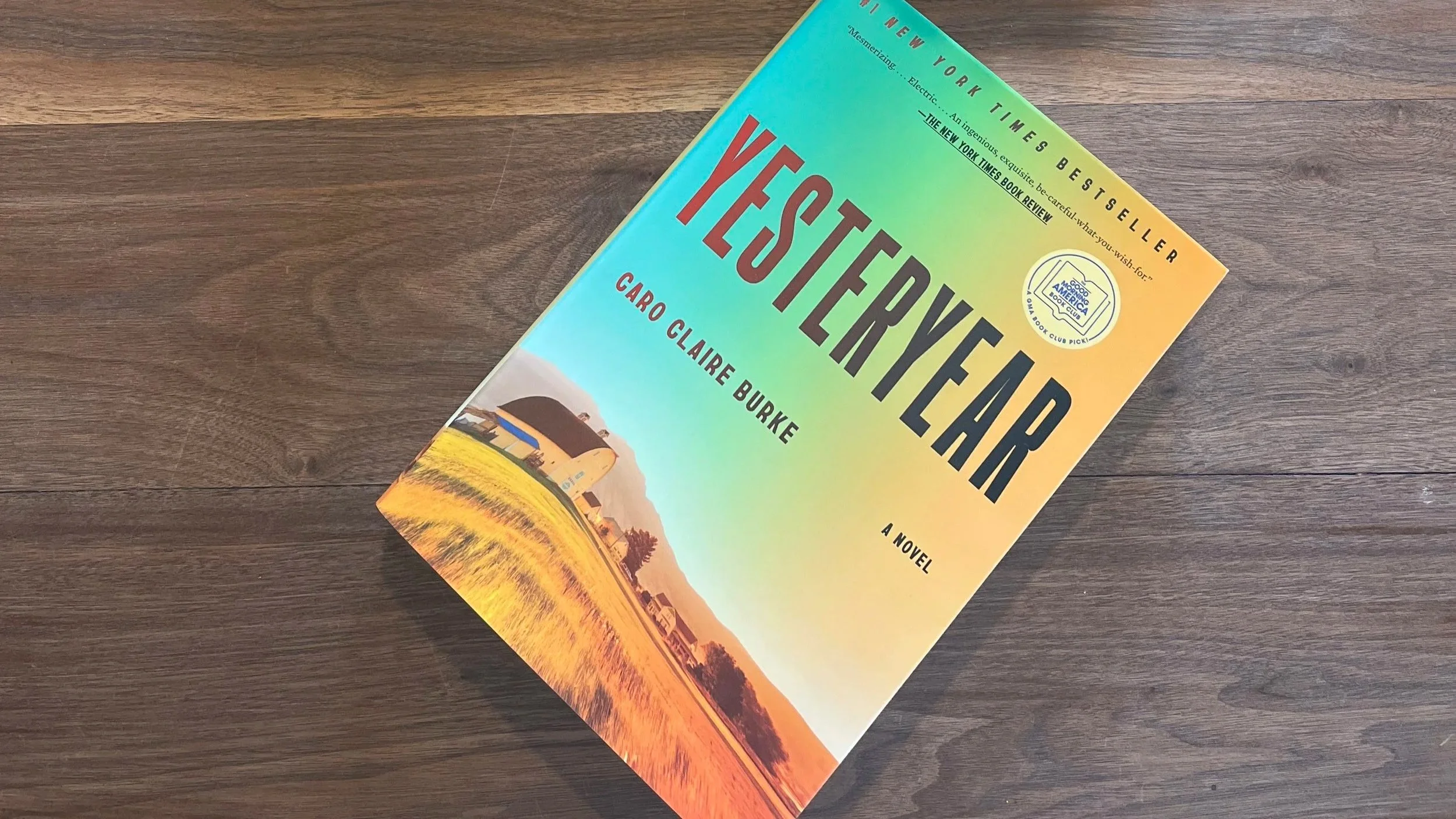
Before you decide whether to read Yesteryear by Caro Claire Burke, you should know two things.
First, many Christian women strongly dislike it.
Second, I couldn’t put it down.
I’ve spent the last few days carrying it from room to room, reading while dinner cooked, staying up later than I should have, and texting friends my increasingly ridiculous theories. Every time I thought I’d solved the mystery, Burke pulled the rug out from under me.
I thought I was reading a thriller about time travel. I was actually reading a story about identity.
Why Some Christian Women Didn’t Like It
I understand why this novel is divisive.
Some readers will read scenes as irreverent or uncomfortable. Others may feel Burke is too sympathetic toward ideas they disagree with. But I wonder whether part of their discomfort comes from the fact that satire rarely lets any of us stay safely outside the story.
If you’re expecting a traditionally “clean Christian novel,” this isn’t it. The characters are messy. The narrator is deeply flawed and deeply unreliable (my favorite kind). There are intentionally jarring scenes. At first glance, it can even feel as though Burke is poking fun at traditional Christianity or conservative womanhood.
I don’t think that’s what she’s doing.
One of the easiest mistakes we can make with fiction is assuming that every belief held by a character is also held by the author. A character may be confused. That doesn’t necessarily mean the author is. Sometimes they’re inviting us to notice precisely where a character’s thinking has become distorted.
I think Burke’s doing something far more interesting than mocking “tradwives” or traditional Christianity. Whether she intended it or not, I found myself asking a question that reached far beyond the pages of this novel:
What happens when the life we’re performing becomes more convincing than the life we’re actually living?
Natalie Is Awful… and That’s the Point
Natalie frustrated me from the very beginning.
She’s intelligent, but she’s also remarkably good at convincing herself that she’s someone she isn’t, especially when the internet validates the version of herself she wants to believe. As the novel progresses, she becomes harder and harder to trust. Ironically, I found her most likable during her time in 1855. Only later did I understand something more devastating about that irony.
She wasn’t becoming more grounded in reality.
She was becoming more grounded in herself.
That observation haunts me a bit.
How often do we become unreliable narrators of our own lives? How often do we tell ourselves stories that are just convincing enough to keep us from asking tougher questions?
As awful as Natalie was, I’d be lying if I said I didn’t recognize parts of myself in her. I suspect many of us would, if we’re wiling to be honest.
Thousands of Mirrors
The internet gives us thousands of mirrors and very few windows.
Mirrors keep our attention fixed on ourselves. Windows invite us to look beyond ourselves.
Social media isn’t just smoke and mirrors. It’s the mirror room at a carnival. Every reflection exaggerates something, minimizes something else, and begins to convince you that the distortion is reality.
Every scroll asks: What identity should you adopt? What aesthetic fits you? Which version of yourself receives the most applause?
It’s easy to assume this novel is primarily about social media or “tradwife” culture, but I think it’s asking something much older than that. The serpent’s first temptation wasn’t simply to eat the fruit. It was to believe that the life God has given wasn’t enough, and that something better existed somewhere else.
That lie didn’t begin with Instagram.
Instagram simply gave it a new platform.
Faith Performed
One of the novel’s greatest strengths is that it doesn’t simply critique social media. It also explores what happens when faith itself becomes performance.
Not false faith.
Performed faith.
Faith used to gain status. Faith used to construct an identity.
I appreciate that Burke never clearly identifies Natalie’s denomination. She leaves the door open for all of us. The temptation to perform our faith isn’t unique to one church. It belongs to every human heart.
The places where faith and human sin become tangled together are often surprisingly familiar. Certainty becomes pride. Community becomes conformity. Identity becomes appearance. We slowly begin confusing what we do for God with whether we are near to Him.
That struck me because Natalie often seems convinced that God only delights in her when she’s performing well. She never seems quite able to rest in simply being loved.
Watch the Questions
One detail fascinated me all the way through the novel.
Mary asks questions.
Clementine asks questions.
Natalie avoids answering them.
The pattern isn’t accidental — questions require vulnerability.
It reminded me of how often Jesus asked questions. Not because He lacked answers, but because questions revealed people’s hearts.
Natalie seems deeply uncomfortable with curiosity because curiosity requires admitting she doesn’t know herself nearly as well as she thinks she does.
Experience vs. Presence
A couple passages particularly puzzled me — where Natalie confuses the presence of God with intense emotional and even physical experience.
At first, I couldn’t understand why Burke included it.
Then I remembered something C.S. Lewis wrote: Our deepest longings are real — we simply mistake what they’re pointing toward. Natalie almost seems to do the reverse. She mistakes her longing for God as something else entirely. Or perhaps she mistakes intense feelings for communion with God.
The result is tragic.
When the feelings disappear, she believes God has disappeared too.
How many of us have done the same?
The Horror Wasn’t Magical
For much of the novel, I searched for a supernatural explanation.
Then Burke dismantled every theory I had.
The real horror wasn’t fantastical. It was ordinary.
It is frighteningly possible to wake up one day and realize you’ve built a life you no longer recognize — not because of one catastrophic decision, but because of hundreds of tiny ones. Almost imperceptibly, we become strangers to ourselves.
That may be the most terrifying thing about the novel.
It could happen to anyone.
The Question I Couldn’t Escape
As I closed the book, I wasn’t thinking about the mystery anymore.
I was thinking about myself.
That’s the mark of great fiction. It doesn’t simply ask questions about its characters, but quietly begins asking them of its readers.
As someone whose work exists online, I found myself asking a question I hope to never stop asking:
Am I inviting people to look at me, or am I inviting them to look up?
I don’t want the people who know me best to watch something I post and wonder who they’re looking at. I want my family and closest friends to recognize the same Nikki off— and online.
Satire — which Burke is exceptional at — has a way of exposing us. When we feel seen in uncomfortable ways, we have a choice. We can become defensive, or we can become curious.
This book didn’t leave me defensive. Not of social media, Christianity, or modern culture.
It left me wanting to become more honest, more present, and more congruent. It reminded me that the goal isn’t to become a more convincing version of myself. It’s to become the woman God already knows me to be; and to be that same woman whether I’m sitting at my kitchen table, on my front porch, in church on Sunday morning, or posting on Instagram on a Tuesday afternoon.
My Five-Star Review
Yesteryear has earned a permanent place on my bookshelf.
I closed the book with more questions than answers, and I mean that as the highest compliment. Not because the novel failed to resolve itself, but because it continued its work after the story ended.
It made me examine my own life, and those are the books worth keeping.